
ABstraction FABrication
This studio aims to investigate the influence of new technologies on design processes,
This studio aims to investigate the influence of new technologies on design processes,

 Opimizing panel layout strategies to minimize wastage. Unfortunately, I can't afford CATIA which has a wonderful feature which allows you too automatically optmizes the layout with just a few clicks. For this project, panels are unfolded with Pepakura (an origami program) and autoCAD is use to mamnually place and align the panels, inc. the numbering.

Interim Review-
 Intention: To explore the notion of surface in architecture. Methodology: Divide + Conquer~!
 Digital JIG modeling with Generative Components
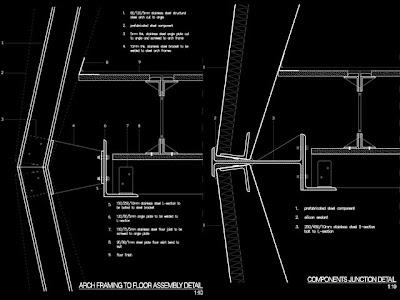
 Assembly of the structural members that are unfolded manualy with autoCAD
Discovery of non planar surfaces that are almost impossible to design it with tolerence because of the surface curvature.
material + form hyphothesis:
1 For quads to 'behave' properly (structurally sound + ease of assembly), increment of the offset splines must be of the exact same amount. Can be explained by Foster's building whenever he uses quads, his form is symmetrical.


